Force Urbania or tempo traveller? The ₹7 per kilometre question
· 6 min read
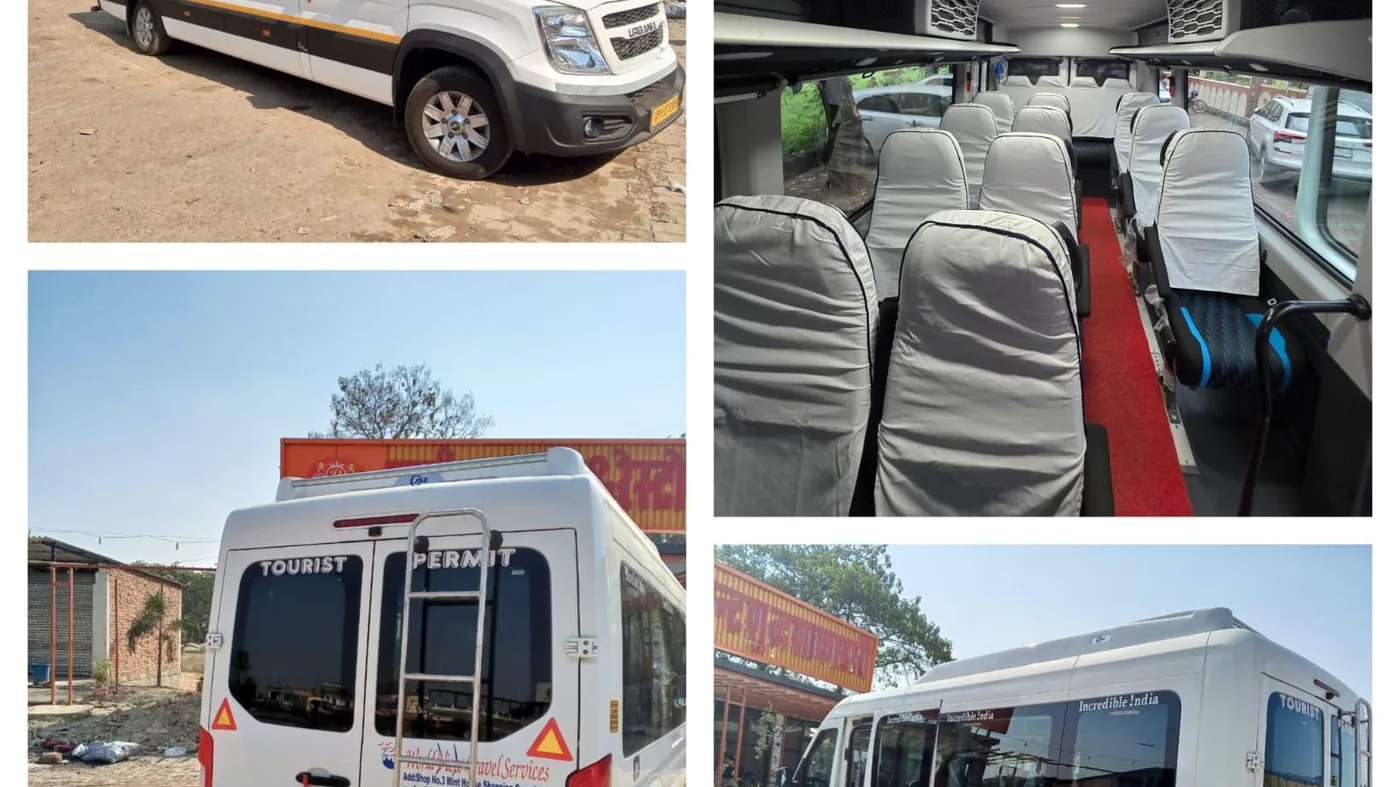
On most Varanasi operators' fleet pages the Force Urbania sits directly below the 17-seater tempo traveller, seven rupees a kilometre dearer, described as "luxury". That framing suggests a trim level. It is not — they are different vehicles built on different principles.
The mechanical difference
| Tempo Traveller 17 | Force Urbania 17 | |
|---|---|---|
| Structure | Ladder frame | Monocoque |
| Rear suspension | Leaf spring | Air suspension |
| Seats | 17 | 17 |
| Luggage | 12 bags | 10 bags |
| Floor height | Standard step | Low step |
| Per km | ₹23 | ₹30 |
| 8 hr / 80 km | ₹4,199 | ₹4,999 |
| 12 hr / 200 km | ₹5,299 | ₹5,999 |
| Driver allowance | ₹350/day | ₹400/day |
A ladder frame carries the body on a separate chassis, which is robust, cheap to repair and transmits a great deal of road noise and vibration into the cabin. A monocoque makes the body itself the structure — quieter, stiffer, and noticeably flatter through corners. Leaf springs are a commercial-vehicle solution; air suspension keeps the ride height constant and absorbs the patched, broken sections that make up a good deal of the Grand Trunk Road.
What it costs in practice
On a 250 km outstation day the Urbania costs ₹7,500 against the tempo traveller's ₹5,750 — a difference of ₹1,750, plus ₹50 more driver allowance. Across seventeen passengers that is about ₹106 per person for the day.
Put like that the decision is easier than the per-kilometre gap suggests. The question is not whether ₹30/km is worth it, but whether ₹106 a head is worth a quieter five hours.
When the Urbania is genuinely worth it
- Any leg over about three hours. Fatigue is where the suspension earns its money, and Varanasi to Bodhgaya is five to six hours.
- Groups with elders. The low floor step matters more than anything on the spec sheet when someone is boarding fifteen times a day.
- Client and corporate travel, where the vehicle is part of the impression.
- Anyone who gets carsick. Body roll on a leaf-sprung traveller over broken road is the usual cause.
When it is not
Short city days. On an 8-hour Varanasi local package you spend most of the time stationary in traffic or parked while the group is inside a temple, and you are paying ₹800 more for suspension you never load. Take the tempo traveller and put the difference toward a better hotel.
It is also the wrong vehicle for a purely price-led booking. If the group will genuinely not notice — a student trip, a large family used to road travel — the tempo traveller carries the same seventeen people to the same places. We would rather say so than sell up.
The thing neither one solves
Neither vehicle reaches Kashi Vishwanath. Both stop at Godowlia crossing and everyone walks about ten minutes through Vishwanath Gali. Air suspension does not change municipal access rules, and any operator implying their vehicle gets closer is selling something that does not exist.
Common questions
- Is a Force Urbania worth the extra cost over a tempo traveller?
- On journeys over three hours, with elders in the group, or for client travel — usually yes, and the gap is about ₹106 per passenger on a 250 km day. On short city itineraries, usually not: you pay for suspension you never use.
- How much does a Force Urbania cost per day in Varanasi?
- ₹4,999 for 8 hours and 80 km, ₹5,999 for 12 hours and 200 km, or ₹30 per kilometre outstation with a 250 km per day minimum, plus ₹400 a day driver allowance. GST, toll and parking are extra.
- Does the Urbania have air suspension?
- Yes, and that plus its monocoque body is the substantive difference from a tempo traveller, which uses a ladder frame and leaf springs. It is why the cabin is quieter and flatter over bad road.
Ready to book a van?
Send your dates and any darshan slot you hold — we build the driver’s day around it.